
You’ve got a page-one ranking. Your website’s traffic’s through the roof. But enrollments aren’t looking good. What gives?
Rankings aren’t the goal; enrollments are. SEO tactics get you found, but a digital marketing strategist decides who finds you, what they find, and what happens next. And with the rise of generative engine optimization (GEO) and answer engine optimization (AEO), their role matters more than ever.
Why Rankings Alone Won’t Cut It
A top ranking no longer guarantees a click. Advanced Web Ranking’s 2026 CTR study found that AI Overviews cut the position 1 organic click-through rate (CTR) on Google US desktop by 52%, from 20.02% to 9.69%. Every sector, higher education included, is adjusting to fewer clicks from the same rankings.
Chelsea Shetty, Apollidon’s content and SEO growth specialist, sees the same shift from the inside: “We can’t only rank for one short keyword anymore. People are asking much more specific questions … That means our content needs to answer real questions clearly, cover topics thoroughly, and give people a reason to continue to our site.”
What a Strategist Actually Does
A digital marketing strategist leads your online presence across every channel, seamlessly connecting search visibility to your target audience, sales funnel, and bottom-line goals. And while they may not go by that exact title (at Apollidon, most of our team has a hand in strategy), the good ones look past vanity metrics to find out what really drives enrollments.
From Keyword Research to Spreadsheets
So, what does that look like day to day? Chelsea says some days she’s researching keywords for SEO and drafting content marketing articles. Other days she’s in Google Search Console and Google Analytics, looking at what’s performing and where the opportunities are.
“There’s definitely a lot of staring at spreadsheets involved,” she says of the less glamorous side of her role. But that’s the job: It’s research, data, and judgment, not a checklist.
Why Data Skills Matter Most
Of the three, reading the data is the skill people underestimate most. As Chelsea says, “A page losing clicks doesn’t automatically mean the content is bad.” You have to look at impressions, rankings, CTR, search behavior, and SERP changes before you touch anything. Otherwise, you “fix” a page that wasn’t broken.
And SEO doesn’t exist in a vacuum. It shares data and messaging with paid search, email, and social media, and someone has to connect those dots. Jose Rodriguez, Apollidon’s marketing content director, agrees: “Marketing is so fast-paced; there’s little to no downtime between projects. So, having strategists on your team who can step back and look at the big picture and how everything connects—that’s huge.”
In higher education, that big picture starts with the student.
What Strategy Looks Like for Higher Education Content Marketing
Strategy in higher education content marketing means building content for every stage of a student’s decision. Before dropping thousands of dollars, prospective students want to know about cost, accreditation, career outcomes, and whether a program fits their life. “They could search dozens of questions before they’re anywhere near ready to apply,” Chelsea says.
Good strategy supports that whole student journey, from the first search of “what can I do with this degree?” to the moment someone finally hits apply.
Match the Content to the Decision
Someone early in their search wants to know about local colleges. Someone further along is comparing online with on-campus or weighing cost against career payoff. Each stage needs its own pages, and a strategist builds that map before a single word gets written.
“When planning content, you have to look beyond trends,” Jose says. “A fun article that draws thousands of visitors to your site isn’t going to lead to results unless you also have middle- and bottom-of-funnel content to move them along.”
In other words, the goal is attracting the right traffic: people likely to move further down the enrollment funnel, not traffic for traffic’s sake.
Many degrees, even online degrees, can cost more than $40,000. No one spends that kind of money on impulse, which is why strategy is critical. If every piece of content is a hard sell, it’ll fall flat. That’s why Chelsea’s focus is mainly on conversational queries and “question-based headings and content closer to a prospective student’s actual decision, like cost, career outcomes, program comparisons, requirements and timelines.”
Build for Skimmers and AI Search
Prospective students aren’t the only ones reading your content. AI search tools are reading it, too. In practice, that means delivering content structured for multitasking, tab-hopping skimmers and AI search. Fortunately, three rules apply to both:
- Answer first. Lead with the point, then add the detail (the inverted pyramid).
- Frame your H2s as questions. Answer each one right away in the copy.
- Cut the fluff. If a sentence doesn’t earn its spot, lose it.
AEO and GEO have marketers rattled, but Jose isn’t worried. “SEO is evolving,” he says, “but at the end of the day, content that’s featured is clear, authoritative, and well-structured. That’s always been the case, whether we’re talking about SERPs [search engine results pages], AI Overviews, or sources cited by chatbots like ChatGPT.”
Back Every Answer With Authority
Google’s own guidance supports this. Its quality raters evaluate content using E-E-A-T: experience, expertise, authoritativeness, and trustworthiness. The takeaway is simple: Be more useful and more credible than what’s already out there.
Lead every section with a direct answer, then back it up with specifics: named organizations, real data, and defined terms. “Growing field” doesn’t count as a data point. Not only do specifics give you a greater chance of being cited in AI Overviews, they also build quick credibility with readers who only skim your content.
Put Faculty Expertise to Work
Faculty members are busy. But if there’s a rare opening in their schedule, have your content writers schedule an interview with them. Their experience, expertise, and unique perspective lend credibility to your program’s blog posts and testimonials, and Google will be more likely to cite content that features their quotes.
Strategist vs. DIY vs. Freelancer
In-house teams can support SEO, but few have the time to own it. Planning to have your admissions team or marketing team handle SEO on the side? They can certainly help, since they know the audience and the programs so well.
The catch is that SEO is now a specialized and ongoing discipline. It covers keyword and intent research, content optimization, technical considerations, internal linking, performance analysis, and AI search visibility—on top of traditional Google.
Comparing Your Options
So who should own SEO? Most programs choose among three options:
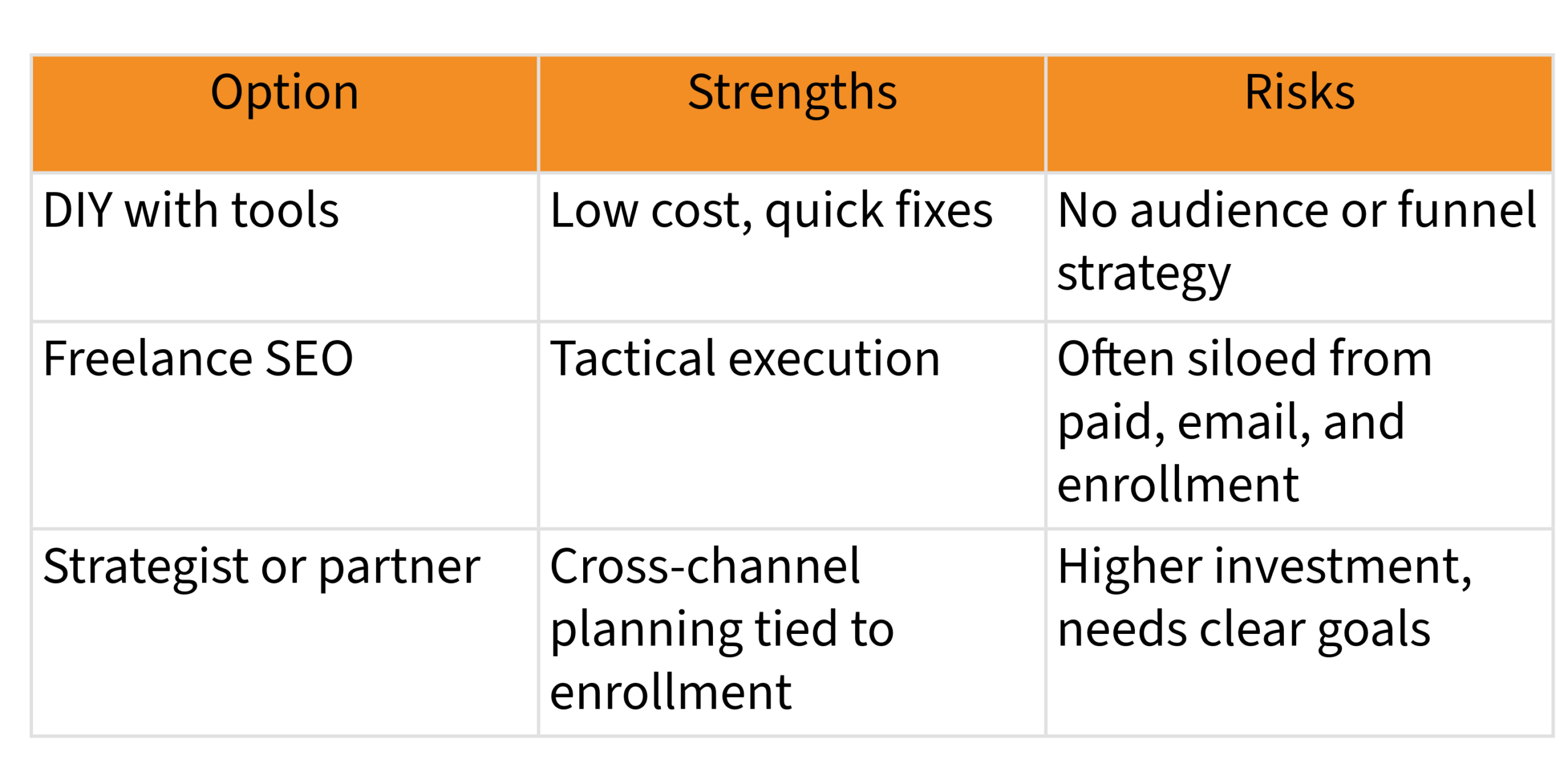
DIY tools and freelancers can fix individual pages, but a strategist turns those fixes into enrollments.
The Cost of Waiting (and How to Know You’re Ready)
Doing nothing isn’t neutral. If your program doesn’t show up while someone researches degrees, careers, costs, and admission requirements, another university becomes the resource they find instead.
Competitors who keep publishing useful content and updating old pages build visibility on those topics, and your program gets harder to find. “You can’t optimize something once and assume it’ll perform exactly the same forever,” Chelsea says.
Are You Ready for a Strategist?
You probably are if:
- Traffic is up, but leads aren’t.
- Nobody clearly owns your higher education content marketing.
- You have no plan for AI search visibility.
- Your reports stop at rankings.
Whether you hire in-house or bring in a partner, ask how they measure success. A strong answer ties traffic and rankings to inquiries, applications, and enrollments. Be wary of anyone who judges success by one metric alone.
With Apollidon Learning, you don’t get just one digital marketing strategist; you get a whole team of marketers who aren’t afraid of spreadsheets—or of putting in the work that drives enrollments.
Not sure where your SEO is leaking? Let’s take a look together.